A folder of documents is not automatically knowledge inside a language model. Putting both on the same computer does not change that. The system needs a way to find the relevant material and supply it with the question.
LocalGPT is an interesting example of that direction. The practical attraction is a conversation with local documents using a locally running model. The useful engineering question is how the answer remains connected to the files, rather than merely sounding as though it has read them.
Build a path back to the page
A typical retrieval workflow begins by extracting text, dividing it into passages, and building an index. At question time, the system searches for relevant passages and includes them in the model's context. The model then writes an answer from the material it receives.
Each step can lose information. A PDF extractor may scramble columns. A table may become a line of unrelated numbers. A passage boundary may separate a statement from the condition that limits it. The language model cannot reliably repair a distinction that never reaches its input.
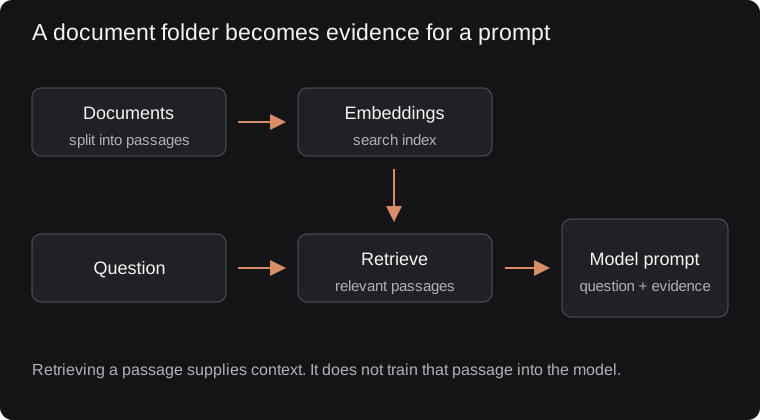
Retrieval supplies selected evidence to a prompt. It does not train the contents of the folder into the model.
Consider a manual that says a device supports a mode only with a particular firmware version. If the passage contains the mode but omits the version requirement, the answer can be confident and wrong while faithfully using the retrieved text. Retrieval quality is therefore part of answer quality.
For every indexed passage, I would retain its filename and a useful location, such as page or section. The answer should offer a path back to the source. A citation that opens the whole 300-page manual is better than none, but a citation that points to the relevant paragraph is much easier to check.
Similarity is not the same as an answer
Embedding-based search finds passages with related meanings. That is valuable when the user's wording differs from the document's. It can be less decisive when the question depends on an exact identifier, a number or a distinction between versions.
A query about model AB-120 might retrieve a very similar section about AB-125. Those passages can be close in semantic space while having different operational implications. Combining semantic retrieval with exact matching and metadata filters can be more useful than assuming one search method covers everything.
The absence of a good passage also needs a visible outcome. If the folder does not contain the requested fact, the assistant should be able to say so. Otherwise a system advertised as "chat with your documents" quietly becomes a general model answering from elsewhere in its training.
That is testable. Prepare a few questions whose answers are present, a few requiring two passages, and a few the documents cannot answer. The last group is especially useful. It reveals whether the assistant distinguishes missing evidence from an invitation to improvise.
Local still needs a clear boundary
Keeping inference and retrieval on the device can reduce the need to send documents to a service. The complete setup must still be examined: model downloads, embedding generation, telemetry and optional integrations may have their own behavior. A privacy claim should describe the actual configuration.
Updates introduce another quiet problem. If a file changes, the index needs to reflect it. Old passages should not continue answering questions about a replacement document. The source identity and indexing state belong in the application, even if the interface tries to keep them unobtrusive.
I would start with a small, well-understood collection. It is easier to judge whether the assistant found the right section in ten familiar documents than in a drive full of unrelated files. Once the retrieval path is dependable, increasing the collection becomes a more meaningful experiment.
The language model makes the interface pleasant, but the evidence path makes it useful. A good document assistant should save the time spent finding and assembling relevant material while leaving the reader able to inspect the material themselves. The folder remains the reference; the conversation becomes a convenient route into it.