Buying a numbered token and preserving a digital artwork are different operations. They can be connected, but the connection has to be designed and maintained.
The useful place to start is the ERC-721 specification. It defines interfaces for identifying tokens, tracking their ownership and transferring them. Metadata is an optional extension. A token URI can lead to a JSON document, which can in turn point to an image. The blockchain entry, the description and the media may therefore live in different places.
Follow the references
Imagine a token whose metadata URL is on a normal web server. The server returns a title and an image URL. A marketplace fetches both and presents an attractive page. From the buyer's perspective, these parts can feel like one object, even though they have different dependencies.
A simplified metadata response might look like this:
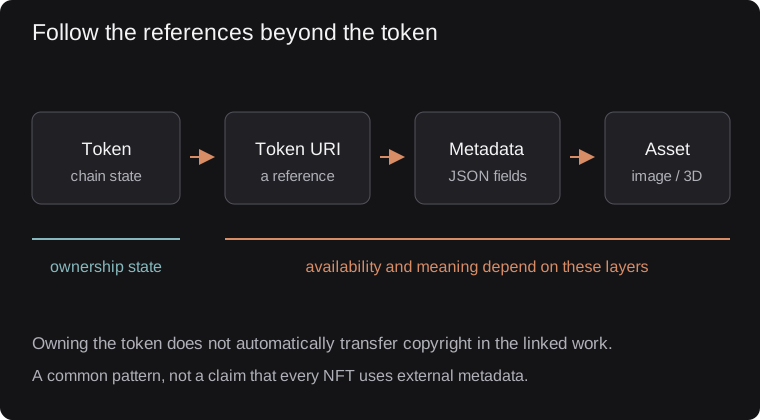
A common chain of references, not the only possible NFT design. Metadata is optional in ERC-721 and some works keep data on-chain.
{
  "name": "Study 17",
  "description": "A generative drawing",
  "image": "https://media.example.test/study-17.png"
}
This illustrative JSON contains a reference to an image, not the image bytes. The server hosting the metadata and the server hosting the image can be operated separately. A buyer seeing one marketplace card may have no reason to notice that separation until something stops loading.
The viewer may also cache an earlier response. Two services can then present different versions of the same referenced object for a while. That is an ordinary web-distribution problem with a token attached to it. A clear design needs to specify which information is authoritative and how updates are discovered.
If the image host disappears, the token record may remain perfectly intact. If the metadata changes, the marketplace may show different information. If the marketplace stops operating, another interface might still read the contract, but it needs enough information to reconstruct the presentation. Each failure occurs at a different layer.
Content-addressed storage changes an important part of that arrangement. An identifier derived from content can help establish that retrieved bytes match an expected object. But knowing which bytes are wanted is not the same as ensuring someone continues to serve them. Availability still needs storage, replication and a reason for those services to remain in operation.
I would draw the whole chain before making a claim about permanence: contract, token identifier, metadata reference, media reference, storage and viewer. Then ask what can change at each connection and who has the ability to change it. A system with a mutable URI has different properties from one whose relevant content is embedded directly in the contract.
Preserve an experience, not only a reference
The file format deserves attention as well. A JPEG is fairly easy to display in many tools. An interactive work may depend on scripts, libraries, remote APIs or a particular runtime. Preserving its main file can leave much of the experience missing. This problem exists outside NFTs too, but a token does not make it disappear.
There is another common ambiguity around the word ownership. The token's ownership record describes control of that token under its contract. It does not by itself describe every permission attached to the artwork. Any license or other agreement needs to be understood on its own terms.
For me, the interesting question is less whether a token can be unique and more whether the complete work can remain intelligible. Can a future viewer find the media, verify what it is, and display it without depending on one company's interface?
A durable digital object needs a clear answer across several layers. The token can be one of those layers. Treating the rest as part of the design makes the promise much easier to evaluate.