Imagine storing a scene without starting from a collection of triangles. Instead, store a function that answers two questions at a location: how much material is here, and what color does it appear from this direction?
That is the useful entry point to the original Neural Radiance Fields paper. NeRF learns a continuous representation from photographs with known camera poses. The network predicts density and color, and a volume renderer combines those predictions into images. The March 2020 paper is about synthesizing new views of an observed scene, not generating an arbitrary world from a single photograph.
Building a pixel along a ray
For one output pixel, the renderer casts a ray from the virtual camera. It samples positions along that ray and asks the network about each one. Dense samples can contribute color while reducing how much of the more distant samples remains visible. Empty space contributes little. The final pixel is an accumulated result along the line of sight.
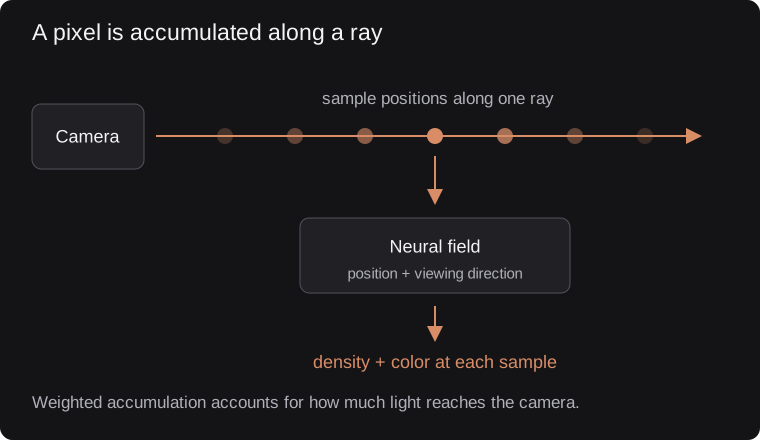
One output pixel comes from weighted contributions along a ray. Density affects both the contribution of a sample and visibility of later samples.
A simple compositing rule helps explain what "accumulated" means. Let a sample's density be sigma and the length of its small interval along the ray be delta. Its opacity contribution is:
alpha = 1 - exp(-sigma * delta)
weight = remainingVisibility * alpha
pixelColor += weight * sampleColor
remainingVisibility *= (1 - alpha)
This is a conceptual front-to-back accumulation, leaving out the sampling strategy and other implementation details. Density and interval length work together. Dividing one region into smaller intervals should not make it arbitrarily more opaque just because the renderer took more samples.
Suppose the first visible region absorbs half the light along the ray. It contributes a weight of 0.5. A second region with the same opacity contributes only 0.25, because half the visibility has already been used. The remaining 0.25 can reach the background. This is why a distant bright sample cannot simply be added at full strength through a dense foreground.
The learned density therefore participates in visibility as well as shape. It tells the renderer where color can contribute and how much of the scene behind it remains available. A thin structure can matter greatly even when it occupies only a short interval along the ray.
Learning agreement between photographs
Training uses the same path in reverse. Render a pixel from a camera whose photograph is available, compare it with the photograph, and adjust the network to reduce the error. Repeat across many views. A representation that only explains one photograph badly explains the others, so agreement between views constrains the scene.
The direction input matters. A shiny tabletop does not have one fixed appearance. Move your head and the reflection changes, even though the surface stays put. Allowing color to depend on viewing direction gives the representation a way to reproduce those effects without assigning every surface a single baked color.
A movable view is only one kind of asset
This also explains why I would be careful about calling the output a finished 3D model. A radiance field is optimized to reproduce views. A game object needs other things: a usable collision surface, predictable behavior under new lights, and a structure that can be edited or animated. Those properties do not automatically appear because the rendered camera movement looks convincing.
There are capture constraints as well. If a vase is photographed only from the front, its unseen back remains weakly constrained. If somebody moves between photographs, the observations no longer describe one consistent static scene. More input images help only when they add useful coverage and maintain the assumptions the method needs.
A good way to read the results is to imagine two tests. First, move smoothly between cameras near the photographs. Second, take the camera somewhere the capture never covered. The first tests interpolation through observed space. The second asks the representation to make much larger guesses. I would not expect them to behave equally well.
What excites me is the change in what can count as a scene description. Geometry, appearance and rendering are tied together by an optimization problem. That creates a different route from photographs to a movable viewpoint, and a new set of practical questions about how to capture, inspect and eventually use the result.