Put several cameras in a ring and it is tempting to imagine the rest as an editing task. Each camera records its part of the world; software joins the edges. That picture leaves out the most difficult condition: all those cameras must describe a compatible moment from compatible viewpoints.
Facebook's Surround 360 announcement describes a combined hardware and software system, with designs and stitching code promised for release. I think that combination is the point. Stitching cannot be considered separately from the way the images are captured.
A seam can be a time difference
Imagine somebody walking across the boundary between two cameras. If one camera records the person slightly later, their body occupies two different positions. A blend across the overlap produces a ghost. A sharper seam produces a discontinuity. Neither operation restores the missing agreement about time.
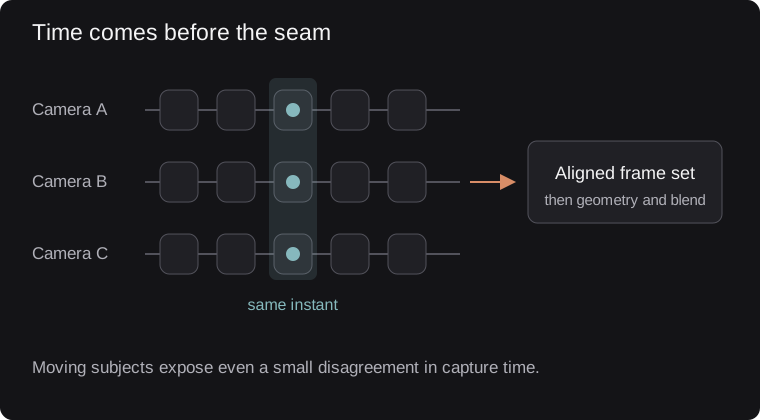
A common capture instant comes before calibration and blending. The diagram is conceptual, not a timing measurement.
For a stationary scene, that error can disappear and make the system look better than it is. This is why a useful capture test needs motion through the overlap. A still room can hide a temporal problem behind an apparently clean panorama.
Exposure also has a temporal component. Two cameras can capture the same instant with different shutter settings or respond differently to a change in brightness. The seam then becomes a change in noise, blur or tone. Correcting brightness after capture may help the appearance, but it cannot recover detail that one sensor clipped away.
Stereo makes agreement stricter
A monoscopic panorama asks for an image that looks continuous. Stereo asks for two images whose differences make geometric sense. The left and right views should communicate depth, not contradictory instructions about where an object is.
An overlap that seems harmless in one eye can disturb that relationship. Moving the seam away from an interesting object may improve a single view while producing an inconsistent pair. A stereo pipeline therefore has to judge the pair together, particularly around nearby objects where viewpoint differences are large.
There is an instructive tension here. More cameras can provide more coverage and more observations. They also create more relationships to calibrate and more streams to coordinate. Counting lenses is a poor substitute for understanding the geometry and timing of the complete rig.
Test the assumption, not the demonstration
For a hypothetical evaluation, I would choose a person moving through a seam, a close object against a distant wall, and a scene containing both bright and dark areas. Each exposes a different kind of disagreement. These are diagnostic scenes rather than impressive scenes, which makes them more useful early in development.
The final panorama is the visible product of many agreements made earlier: where each camera was, how its lens mapped the world, when it exposed, and how its output relates to the other eyes. Good software can exploit those agreements. It has a much harder job inventing them after the fact.